Cintesi Furniture
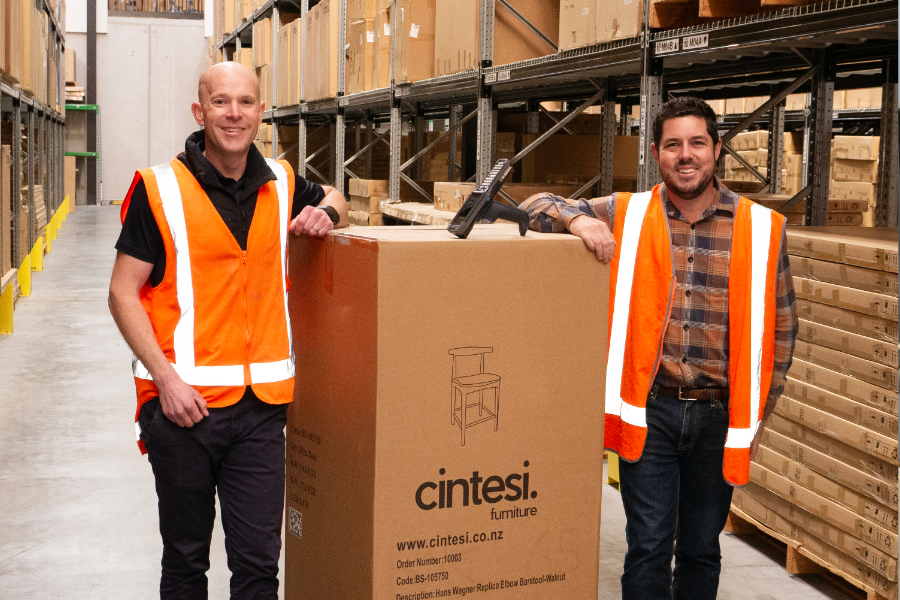
"Automatic tracking of bin movements gives us huge efficiencies in terms of our picking and put-away, making sure products are going into the same general location as the rest of that range.”
For over 35 years, New Zealand-owned Cintesi Furniture has supplied high-quality residential, commercial and hospitality furniture to clients nationwide.
As a second-generation family business operating across two branches—a head office and warehouse in Tauranga and a showroom in Auckland—Cintesi manages a complex supply chain, sourcing products from across the globe.
However, as the business scaled, its reliance on manual processes began to create operational bottlenecks. By leveraging the flexibility of the Accredo accounting and business management software, Cintesi has transitioned from a fragmented system to a highly automated “single source of truth” that now underpins every aspect of its operations.
Siloed Data and Manual Inefficiencies
In 2019, Cintesi reached a point where its internal systems felt outdated. The business struggled with manual inventory recording, particularly regarding stock placement in its multi-aisle/multi-level distribution centre.
“We had the same challenges year in, year out,” explains Sam Stacey, Business Manager for Cintesi. “Quickly finding stock in the warehouse was a challenge as it was too manual to record where the stock was going. New staff were slow to find products; they would drive up and down aisles, and we’d have variations of the same product—different colour stains, for example—that weren’t being validated. It created a lot of headaches.”
Furthermore, the company’s digital presence was hampered by a clunky, legacy integration between its website and the Accredo software. Pricing for special promotions was managed in two different locations, key product information was missing and constantly dropping offline, leading to administrative strain and costly developments to maintain and grow. The team needed a way to consolidate, increase functionality, and automate the flow of data from website orders through to dispatch.
A Custom-Built Ecosystem
To revitalise its operations, Cintesi engaged Accredo Qualified Support Person, Ollie Keesing of Tipako Systems. Keesing’s expertise in customising Accredo helped Cintesi to move beyond off-the-shelf capabilities, creating an ecosystem that aligned with the business’s specific logistical needs.
Warehouse Automation and Bin Tracking
The most significant transformation was the implementation of new warehouse management processes developed in conjunction with Tradie on the Move. Cintesi now utilises mobile devices for all stock movements, from receipt of goods to “wave picking”.
“Any movement into or out of a bin is now fully tracked,” Stacey says. “Being able to record that automatically is critical for us. It gives us huge efficiencies in terms of our picking and put-away, making sure products are going into the same general location as the rest of that range.”
By leveraging this granular bin-level tracking, the warehouse team has gained precise oversight of the entire inventory lifecycle. Every item is now accounted for from the moment it enters the facility until it is dispatched to a customer, eliminating the “lost” stock that previously troubled operations. This system provides real-time visibility into the inflow and outflow of goods, enabling management to monitor stock turnover rates and optimise storage density in the warehouse. Consequently, the reliance on manual paper-based tracking has been replaced by a digital audit trail that ensures stock integrity and simplifies inventory audits.
Seamless Website and E-commerce Integration
Recognising that the business needed a more modern e-commerce approach, Cintesi partnered with web developers Web Paste to build a new middleware solution. This API is an essential bridge, ensuring that Accredo acts as the central hub for all product data, inventory availability, and customer pricing.
“We wanted Accredo to be the one source of truth,” says Jen Stacey, who oversees Cintesi’s website. “All of our special pricing, whether it’s for clearance items or specific trade accounts, is now set in Accredo and flows through to the website. Customers can log in, view their trade pricing, and check out without calling us for a quote. It relieves those types of admin tasks and allows customers to shop at their own pace.”
Efficiency, Accuracy, and Scalability
The transition to a fully integrated, automated environment has fundamentally changed how Cintesi operates, providing real-time visibility and significantly reducing administrative overhead.
The automation extends to the final mile of the customer journey. When an order is placed online, it syncs to an Accredo “order queue”. Once picked, staff use a customised transport management integration to select from preferred carriers, which automatically populates delivery addresses and generates shipping labels.
“It’s pretty touchless on the admin side of things,” says Stacey. “It’s fantastic. It means we don’t have staff logging into carrier web portals to input data; it’s just sucking all the information directly from Accredo.”
Expert Guidance and Future-Proofing
The collaboration with Ollie Keesing proved to be a turning point, helping the team overcome the feeling that they had “hit a ceiling” with the sophistication of their operations.
“Ollie’s previous experience has really opened our eyes. He’s come on board and been able to guide us through what things can be achieved with Accredo. He’s certainly re-energised us on the level of sophistication the Accredo system is capable of.”
By getting the foundation systems right, Cintesi has achieved the granularity needed to manage complex inventory, such as “kit-set” furniture, where components are stored separately but sold as a single unit. With a robust, scalable architecture now in place, the business is well-positioned for future growth, having successfully unified its accounting, warehouse, and e-commerce operations into a seamless, efficient machine.
Further reading:
Related case studies:

YHI implements Accredo WMS to streamline warehouse operations and reduce picking errors